Old Fashion Razor Shaving Hand Machine Using Razor
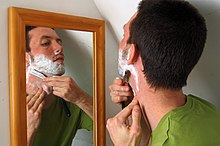


Cartridge razor with two blades
Shaving is the removal of hair, by using a razor or any other kind of bladed implement, to slice it downwardly—to the level of the pare or otherwise. Shaving is most commonly practiced by men to remove their facial hair and by women to remove their leg and underarm hair. A man is called make clean-shaven if he has had his beard entirely removed.[ane]
Both men and women sometimes shave their breast hair, abdominal hair, leg hair, underarm hair, pubic hair, or any other body hair.[2] Head shaving is much more common among men. It is oft associated with religious practise, the armed forces and some competitive sports such every bit swimming, running, and extreme sports. Historically, head shaving has also been used to humiliate, punish and show submission to an dominance,[3] and in more recent history also as office of fund-raising efforts, peculiarly for cancer enquiry organizations and charitable organizations which serve cancer patients. The shaving of head hair is also sometimes done by cancer patients when their treatment may result in hair loss.
History [edit]

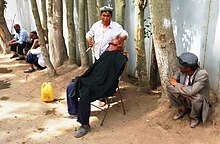
Homo existence shaved with straight razor. Roadside, Kashgar
Before the advent of razors, hair was sometimes removed using two shells to pull the hair out or using water and a precipitous tool. Around 3000 BC when copper tools were developed, copper razors were invented. The idea of an aesthetic approach to personal hygiene may have begun at this time, though Egyptian priests may have practiced something similar to this earlier. Alexander the Smashing strongly promoted shaving the beard for Macedonian soldiers before boxing because he feared the enemy would grab them.[4] In some Native American tribes, at the time of contact with British colonists, information technology was customary for men and women to remove all trunk hair.[5]
Straight razors are known to have been manufactured in Sheffield, England since the 18th century.[six] In the The states, getting a direct razor shave in a barbershop and cocky-shaving with a straight razor were withal common in the early on 1900s. The popularisation of self-shaving inverse this. According to an estimate by New York City barber Charles de Zemler, barbers' shaving revenue dropped from about 50 per centum around the fourth dimension of the Castilian–American War to ten percentage in 1939 due to the invention of the safe razor and electrical razor.[7]
Rubber razors take been known to exist since at least 1876 when the single-edge Star safety razor was patented by brothers Frederick and Otto Kampfe. The razor was essentially a small piece of a straight razor attached to a handle using a clench mechanism. Before each shave the bract had to exist attached to a special holder, stropped with a leather belt, and placed back into the razor. Afterward a time, the bract needed to be honed past a cutler.[8]
In 1895, King Camp Gillette invented the double-edged safety razor, which utilised inexpensive, dispensable blades sharpened from two sides. It took him until 1901 to build a working, patentable model, and commercial production began in 1903.[9] The razor gained popularity during Globe War I when the U.Southward. military started issuing Gillette shaving kits to its servicemen: in 1918, the Gillette Safe Razor Company sold three.5 million razors and 32 1000000 blades. Later on the Offset World State of war, the visitor changed the pricing of its razor from a premium $5 to a more affordable $1, leading to another large surge in popularity.[x] The 2nd World War led to a similar increase in users when Gillette was ordered to dedicate its entire razor production and well-nigh blade product to the U.S. war machine. During the war, 12.5 meg razors and 1.5 billion blades were provided to servicemen.[eleven]
In 1970, Wilkinson Sword introduced the 'bonded blade' razor, which consisted of a unmarried blade housed in a plastic cartridge.[12] [13] Gillette followed in 1971 with its Trac II cartridge razor that utilised two blades.[xiv] Gillette built on this twin blade design for a time, introducing new razors with added features such as a pivoting caput,[15] lubricating strip,[16] and spring-mounted blades[17] until their 1998 launch of the triple-bladed Mach3 razor.[18] Schick launched a four-bract Quattro razor later the same twelvemonth,[xix] and in 2006 Gillette launched the five-blade Fusion.[xx] Since then, razors with half dozen and 7 blades have been introduced.[21] [22]
Wholly disposable razors gained popularity in the 1970s after Bic brought the first dispensable razor to market in 1974. Other manufacturers, Gillette included, presently introduced their ain disposable razors, and by 1980 disposables fabricated up more than 27 percentage of worldwide unit sales for razors.[23]
Shaving methods [edit]
Shaving can be done with a straight razor or safety razor (called 'transmission shaving' or 'wet shaving') or an electrical razor (chosen 'dry out shaving') or bristles trimmer.
The removal of a total beard often requires the use of scissors or an electrical (or bristles) trimmer to reduce the mass of pilus, simplifying the procedure.
Wet shaving [edit]
There are ii types of manual razors: straight razor and condom razors. Rubber razors are farther subdivided into double-edged razors, single edge, injector razors, cartridge razors and dispensable razors. Double-border razors are named and so because the bract that they use has ii sharp edges on reverse sides of the blade. Current multi-bladed cartridge manufacturers attempt to differentiate themselves by having more or fewer blades than their competitors, each arguing that their product gives a greater shave quality at a more than affordable price.

A Gillette 'Onetime Type' prophylactic razor, the first razor to use double-edge razor blades.
Earlier moisture shaving, the area to exist shaved is usually doused in warm to hot h2o by showering or bathing[24] or covered for several minutes with a hot wet towel to soften the peel and pilus. A lathering or lubricating agent such equally foam, shaving lather, gel, foam or oil is normally applied after this. Lubricating and moisturizing the skin to be shaved helps forestall irritation and damage known as razor burn down. Many razor cartridges include a lubricating strip, made of polyethylene glycol, to part instead of or in supplement to extrinsic agents.[25] It also lifts and softens the hairs, causing them to slap-up. This enhances the cutting action and sometimes permits cut the hairs slightly beneath the surface of the skin.[ commendation needed ] Additionally, during shaving, the soap indicates areas that accept not been addressed. When lather is used, it is generally applied with a shaving brush, which has long, soft bristles. Information technology is worked up into a usable lather by the brush, either against the face, in a shaving mug, basin, scuttle, or palm of the hand.
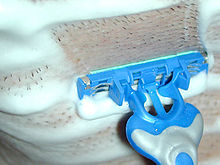
Closeup of a disposable razor shaving stubble off the underside of a mentum. The direction of razor travel is the same as the direction of the stubble hairs or 'grain'.
Since cuts are more likely when using prophylactic razors and directly razors, moisture shaving is generally done in more than ane pass with the blade. The goal is to reduce the amount of hair with each pass, instead of trying to eliminate all of it in a unmarried pass. This also reduces the risks of cuts, soreness, and ingrown hairs. Alum blocks and styptic pencils are used to close cuts resulting from the shave.
Aftershave [edit]
An aftershave balm or balm is sometimes used after finishing shaving. It may incorporate an antiseptic agent such every bit isopropyl booze, both to prevent infection from cuts and to act as an astringent to reduce skin irritation, a perfume, and a moisturizer to soften the facial skin.
Electric shaving [edit]

A rotary design electric razor.

Oscillating blades of a foil-type shaver
The electrical razor (electric shaver) consists of a set up of aquiver or rotating blades, which are held behind a perforated metal screen which prevents them from coming into contact with the skin and behaves much like the second bract in a pair of scissors. When the razor is held against the skin, the whiskers poke through the holes in the screen and are sliced by the moving blades. In some designs the blades are a rotating cylinder. In others they are i or more rotating disks or a fix of aquiver blades. Each blueprint has an optimum motility over the skin for the all-time shave and manufacturers provide guidance on this. More often than not, round or cylindrical blades (rotary-type shaver) move in a circular movement and oscillating blades (foil-type shaver) move left and right. Hitachi has produced foil-type shavers with a rotary blade that operates similarly to the blade associates of a reel-type lawn mower. The first electrical razor was built past Jacob Schick in 1928.
The master disadvantages of electric shaving are that it may not cut the whiskers as closely as razor shaving does and information technology requires a source of electricity. The advantages include fewer cuts to the skin, quicker shaving and no need for water and lather sources. The initial cost of electrical shaving is higher, due to the cost of the shaver itself, just the long-term cost tin be significantly lower[ citation needed ], since the cut parts do not need replacement for approximately 18 months and a lathering production is not required. Some people also find they practice not feel ingrown hairs (pseudofolliculitis barbae, also called razor bumps), when using an electric shaver.
In dissimilarity to wet shaving, electric shave lotions are intended to stiffen the whiskers. Stiffening is achieved past dehydrating the follicles using solutions of alcohols and a degreaser such as isopropyl myristate.[26] Lotions are likewise sold to reduce skin irritation, but electric shaving does not usually crave the application of whatever lubrication.
Mechanical shavers powered past a leap motor have been manufactured, although in the late 20th century they became rare. Such shavers can operate for up to two minutes each fourth dimension the leap is wound and practise non crave an electrical outlet or batteries. Such type of shaver, the "Monaco" brand, was used on American space flights in the 1960s and 1970s, during the Apollo missions.[27]
Bristles trimmer [edit]

Beard trimmer: a prepare of two hinged blades
The mechanics of a beard trimmer involves rotatory mechanics, crafted with a mini size motor, which rounds at a very fast speed. This motor causes a set of two hinged blades to move dorsum and forth past ane another allowing for the hair cuticles to exist cut. The main reward of a beard trimmer, dissimilar other shaving tools is that longer beards tin can be trimmed to a short length efficiently and effectively.
Furnishings of shaving [edit]
Aberrations [edit]
Shaving can have numerous side effects, including cuts, abrasions, and irritation. Many side effects tin be minimized by using a fresh blade, applying enough of lubrication, shaving in the direction of hair growth, and avoiding pressing the razor into the skin. A shaving brush can also help to lift the hair and spread the lubrication. The cosmetic market in some consumer economies offers many products to reduce these furnishings; they commonly dry the affected area, and some also aid to lift out the trapped hair(due south). Some people who shave choose to employ merely single-bract or wire-wrapped blades that shave farther away from the skin. Others take skin that cannot tolerate razor shaving at all; they use depilatory shaving powders to dissolve pilus in a higher place the skin'due south surface, or grow a bristles. Some anatomical parts, such as the scrotum, crave actress care and more advanced equipment due to the uneven surface of the skin when the testicles shrivel during coldness, or its imbalance when the testicles hang depression due to being warmer.[28]
Cuts [edit]
Cuts from shaving can drain for about 15 minutes. Shaving cuts can exist acquired past blade movement perpendicular to the blade's cutting centrality or by regular / orthogonal shaving over prominent bumps on the peel (which the blade incises). As such, the presence of acne can make shaving cuts more likely, and extra care must be exercised. The use of a fresh, abrupt blade likewise as proper cleaning and lubrication of peel can help prevent cuts. Some razor blade manufacturers include disposal containers or receptacles to avoid injuries to anyone handling the garbage.
Razor fire [edit]

The ruby-red spot on this man's neck is razor burn.
Razor burn is an irritation of the skin caused by using a edgeless blade or non using proper technique.[29] It appears as a mild rash 2–4 minutes subsequently shaving (once hair starts to grow through sealed skin) and commonly disappears after a few hours to a few days, depending on severity. In astringent cases, razor burn can besides be accompanied by razor bumps, where the surface area around shaved hairs get raised cherry welts or infected pustules. A rash at the fourth dimension of shaving is usually a sign of lack of lubrication. Razor burn is a mutual problem, especially among those who shave coarse hairs on areas with sensitive skin like the bikini line, pubic hair, underarms, breast, and bristles. The condition can be caused by shaving likewise closely, shaving with a blunt blade, dry shaving, applying too much pressure level when shaving, shaving too speedily or roughly, or shaving confronting the grain.
Ways to prevent razor burn include keeping the pare moist, using a shaving brush and lather, using a moisturizing shaving gel, shaving in the direction of the hair growth, resisting the urge to shave as well closely, applying minimal pressure level, avoiding scratching or irritation afterwards shaving, avoiding irritating products on the shaved surface area (colognes, perfumes, etc.) and using an aftershave cream with aloe vera or other emollients.[30] Putting a warm, wet cloth on 1'south peel helps as well, past softening hairs. This can also be done by using pre-shave oil earlier the awarding of shaving cream. Essential oils such as coconut oil, tea-tree oil, peppermint oil, and lavander oil help to soothe pare later shaving. They have anti-inflammatory, antiseptic, and antibacterial properties.[ commendation needed ]
In some cases multi-bladed razors can crusade peel irritation by shaving too close to the skin. Switching to a unmarried- or double-bladed razor and not stretching the skin while shaving tin can mitigate this.[31]
Ane other technique involves exfoliating the skin before and after shaving, using diverse exfoliating products, included but not limited to, brushes, mitts, and loofah. This procedure removes dead peel cells, reducing the potential for ingrown hairs and allowing the razor to glide across the skin smoothly decreasing the hazard of the razor snagging or grabbing causing razor burn.
Razor bumps [edit]
Pseudofolliculitis barbae is a medical term for persistent inflammation caused by shaving. Information technology is also known by the initials PFB or colloquial terms such equally razor bumps.
Myths [edit]
Shaving does not cause final hair to grow dorsum thicker, coarser or darker.[32] [33] This belief arose because hair that has never been cut has a naturally tapered terminate, equally it emerges from the skin'south hair follicle, whereas, after cutting, there is no taper. The cut hair may thus appear to be thicker, and feel coarser as a result of the precipitous edges on each cutting strand. The fact that shorter hairs are "harder" (less flexible) than longer hairs also contributes to this effect.[34] Pilus tin can also appear darker after information technology grows back because hair that has never been cutting is ofttimes lighter from sun exposure. In addition, as humans grow older hair tends to grow coarser and in more places on the face and body.[35] For example, teenagers may start shaving their face or legs at around 16, but every bit they historic period pilus volition start to grow more abundantly and thicker, leading some to believe this was due to the shaving, only in reality is just office of the maturation process.
Shaving in religion [edit]
Hinduism, Buddhism, Jainism and Christianity [edit]
Hindu, Jain and Buddhist (usually merely monks or nuns) temples have ceremonies of shaving the hair from the scalp of priests, nuns, and certain followers, as a symbol of their renunciation of worldly fashion and esteem. Amish men and some other obviously peoples shave their bristles until they are married, afterward which they allow it to grow merely continue to shave their mustaches. Tonsure is the do of some Christian churches.
In Hinduism, in certain communities, a child'due south birth hair is shaved off equally function of a set of religious rites (samskaras)
Islam [edit]
Sunni [edit]
Shaykh Ibn 'Uthaymeen said: The definition of the bristles as stated by the scholars of (Arabic) language is: the hair of the face, jawbone and cheeks, in the sense that all the hair on the cheeks, jawbone and chin is function of the beard and removing any of information technology is counted as a sin, considering the Messenger said: "Let your beards grow," "Leave your beards alone," "Permit your beards increment," "Let your beards exist total." This indicates that it is not permissible to remove anything from the bristles. Yet, Ibn Omar, a companion of the Prophet Muhammad, used to cutting from his beard anything that outgrew a fist'due south length.
Shia [edit]
According to the Shia scholars, the length of bristles should not exceed the width of a fist. Trimming of facial hair is allowed, however, shaving information technology is makruh (religiously discouraged).[36] [37] [38]
Judaism [edit]
Observant Jewish men are subject area to restrictions on the shaving of their beards, equally Leviticus nineteen:27 forbids the shaving of the corners of the head and prohibits the marring of the corners of the bristles.[39] The Hebrew word used in this verse refers specifically to shaving with a blade against the pare[ citation needed ]; rabbis at different times and places take interpreted it in many means.
Tools like pair of scissors and electrical razors, which cut the hair between two blades instead of between blade and skin, are permitted.
Encounter as well [edit]
- Androgenic pilus
- Barber
- Beard
- Beard Liberation Forepart
- Burma-Shave
- Cutting
- Glabrousness
- Hair removal
- Caput shaving
- Leg shaving
- Pogonotomia, the art of shaving
- Congenial Social club of Law v. City of Newark
- Pubic hair
- Shaving cream
- Shaving soap
References [edit]
- ^ "Make clean-shaven". freedictionary.com. Retrieved 2007-09-26 .
- ^ Susan Breslow Sardone. "What is a Bikini Wax?". almost.com. Archived from the original on 2007-09-eleven. Retrieved 2007-09-26 .
- ^ Mark of a woman (February 20, 2007). "Mark of a woman". BBC News . Retrieved 2007-09-26 . (from internet annal)
- ^ Sherrow, Victoria (2006). Encyclopedia of Hair: A Cultural History (Google eBook). Greenwood Publishing Group. p. 142. ISBN978-0313331459.
- ^ Brownish, Kathleen (2009). Foul Bodies: Cleanliness in Early America. Yale University Press. ISBN978-0-300-10618-three.
- ^ "razor | shaving implement | Britannica.com". Encyclopædia Britannica. Encyclopædia Britannica, Inc. Archived from the original on 24 June 2015. Retrieved 8 June 2017.
- ^ McKibben, pp. 17–18
- ^ McKibben, pp. five–half-dozen
- ^ McKibben, pp. v–14
- ^ McKibben, pp. xviii–21
- ^ McKibben, p. 40
- ^ "History of Mens Shaving". Schick.com. Edgewell Personal Care. Archived from the original on xi August 2016. Retrieved five June 2017.
- ^ McKibben, p. 68
- ^ McKibben, pp. 67–69
- ^ McKibben, p. 96
- ^ McKibben, p. 118
- ^ McKibben, p. 240
- ^ Aoki, Naomi (31 August 2003). "The war of the razors". annal.boston.com. The New York Times Company. Archived from the original on 2 September 2016. Retrieved 5 June 2017.
- ^ "Gillette'due south New Razor: No New Blades!". CBS Interactive Inc. 12 February 2010. Archived from the original on 6 June 2017. Retrieved six June 2017.
- ^ "Gillette unveils v-bladed razor". CNN Money. Cable News Network. 14 September 2005. Archived from the original on half dozen Apr 2016. Retrieved 6 June 2017.
- ^ "Anyway y'all slice it, doesn't a half-dozen-blade razor feel excessive?". The Washington Post. Archived from the original on 11 June 2017. Retrieved 11 June 2017.
- ^ Wells, Jonathan. "Introducing the vii-blade razor (because five simply wasn't plenty)". The Telegraph. Telegraph Media Group Limited. Archived from the original on 12 October 2015. Retrieved 11 June 2017.
- ^ McKibben, pp. 97–99
- ^ "How to shave". aad.org. American Academy of Dermatology. Archived from the original on six September 2015. Retrieved 24 October 2015.
- ^ Braun, David. "Razor component and lubricating strip". Retrieved 23 November 2014.
- ^ "Hair Preparations," Ullmann's Encyclopedia of Industrial Chemistry. Wiley-VCH, Weinheim (2006). doi:ten.1002/14356007.a12_571.pub2
- ^ "Shaver, Mechanical, Apollo – Smithsonian National Air and Space Museum". Airandspace.si.edu. Archived from the original on 2016-03-06. Retrieved 2012-10-xx .
- ^ United States Pharmacopeia Dispensing Information: USP DI, Book 1, Parts i–ii; Volume 2. Micromedex. 1988. p. 77.
- ^ admin (12 Apr 2016). "How To Go Rid of a Razor Fire Speedily". Starting time Wellness Mag . Retrieved 2016-04-20 .
- ^ "How to Go That Perfect Shave". MSNBC. 2005-01-thirty. Archived from the original on 2005-02-04. Retrieved 2011-11-24 .
- ^ "Skin care tips for men". aad.org. American University of Dermatology. Archived from the original on 28 November 2016. Retrieved 3 June 2017.
- ^ "hirsutism / hypertrichosis – does shaving stimulate hair growth / hypertrichosis". Keratin.com. Retrieved 2011-xi-24 .
- ^ "Shaving hair: Does shaved pilus abound back thicker?". MayoClinic.com. 2011-ten-26. Retrieved 2011-11-24 .
- ^ "Shaved Pilus Grows Darker". snopes.com. Retrieved 2009-08-29 .
- ^ "Aging changes in hair and nails". National Institutes of Health. Retrieved 2013-09-01 .
- ^ "Ayatollah Sayed Sadiq Hussaini al-Shirazi » FAQ Topics » Beard". Archived from the original on 3 July 2017. Retrieved eleven March 2017.
- ^ "Bristles – Question & Respond – The Official Website of the Office of His Eminence Al-Sayyid Ali Al-Husseini Al-Sistani". Retrieved 11 March 2017.
- ^ "Applied Laws of Islam". Retrieved 11 March 2017.
- ^ Leviticus 19:27
Bibliography [edit]
- McKibben, Gordon (1998). Cutting Edge: Gillette'south Journey to Global Leadership . Harvard Business School Press. ISBN0-87584-725-0.
Further reading [edit]
- Ham, Michael (2012). "Leisureguy'due south Guide to Gourmet Shaving, sixth edition: Shaving Made Enjoyable," Pogonotomy Press. ISBN 978-1477436806
0 Response to "Old Fashion Razor Shaving Hand Machine Using Razor"
Post a Comment